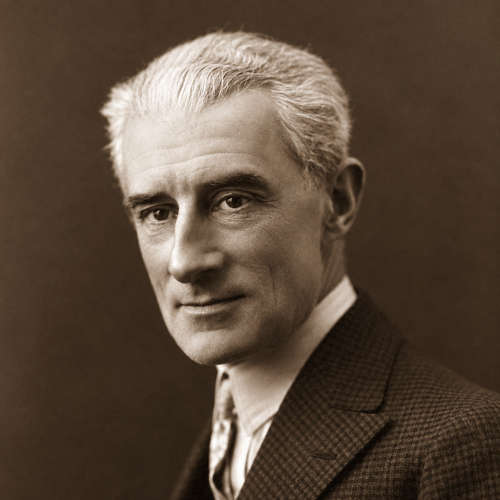
Maurice Ravel – composer (b. 7 March 1875 – d. 28 December 1937)
was a French composer, pianist and conductor. He is often associated with Impressionism alongside his elder contemporary Claude Debussy, although both composers rejected the term. During the 1920s and 1930s, Ravel was internationally regarded as France’s greatest living composer.
Born into a music-loving family, Ravel attended France’s premier music college, the Paris Conservatoire. He was not well regarded by its conservative establishment, whose biased treatment of him caused a scandal. After leaving the conservatoire, Ravel pursued his own path as a composer, developing a style characterized by great clarity and incorporating elements of modernism, Baroque music, neoclassicism and, in his later works, jazz. He enjoyed experimenting with musical form, as in his best-known work, Boléro (1928), in which repetition takes the place of development. Renowned for his abilities in orchestration, Ravel also made orchestral arrangements of other composers’ piano music, the best known being his 1922 version of Mussorgsky’s Pictures at an Exhibition.
A slow and painstaking worker, Ravel composed fewer pieces than many of his contemporaries. His works that entered the...
Read